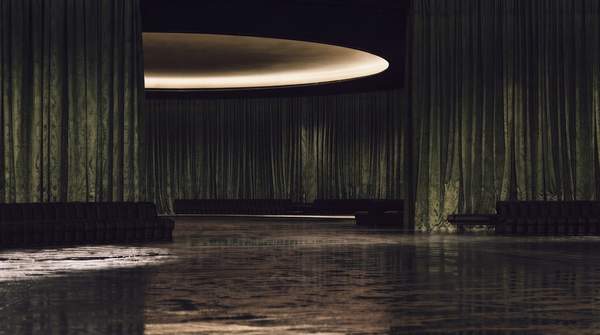
The sets that linger in fashion memory are rarely accidents of staging. Surveying the celebrated runways of the past two decades—from a Chanel supermarket to a Dior palaeolithic dawn—reveals three recurring conceptual strategies: partnering with fine artists, deploying technology as spectacle, and building an entirely transportive world. Each demands a different kind of creator, from credited artists like Daniel Buren to specialized production houses whose names rarely reach the audience. British Vogue's Sam Rogers captures why these constructions matter: "Beyond mere stages, these sets are immersive experiences, as compelling as they are functional."
Conceptual Strategies for Iconic Runway Set Design
| Approach | Featured Show Example | Key Element | Narrative Impact |
|---|---|---|---|
| Artistic Collaboration | Louis Vuitton Spring/Summer 2013, set by Daniel Buren with Marc Jacobs | Four sets of escalators emptying onto a giant yellow and white checked runway | Blends an external artist's signature visual vocabulary with the collection's narrative, making the set a co-authored statement rather than a backdrop |
| Technological Spectacle | Drone-presented fashion shows, including Dolce & Gabbana's drone-carried handbags | Robots or drones replacing or augmenting models as a central element of presentation | Creates a single dramatic, memorable moment—garments presented without human models—and sparks debate over whether tech is substance or spectacle |
| Immersive World-Building | Chanel's supermarket set; Dior's mirrored cave (spring/summer 2018) | A complete, transportive environment that envelopes the audience | Creates a fictional world for the duration of the show, transforming an everyday or fantastical setting into the collection's own logic |
These categories are porous—Dior's A/W 2025 show could be read as world-building or collaboration—but the framework's value is diagnostic. It directs attention to who is responsible for the set, what element carries the meaning, and what narrative work the construction performs.
Artistic Collaboration: When Fashion Meets Fine Art
The clearest signal of this strategy is a named external artist attached to the show. For Louis Vuitton's spring/summer 2013 collection, the artist Daniel Buren collaborated with Marc Jacobs on a set featuring four sets of escalators emptying out onto a giant yellow and white checked runway, as British Vogue's gallery records. The checked floor is pure Buren—his stripes and grids are his signature—and the escalators turned the audience's arrival choreography into part of the composition.
Prada offers a variant of the same move: artists came together to collaborate with Miuccia Prada on a series of murals and illustrations musing on themes of femininity, representation, power and multiplicity. In both cases, the set functions as a dialogue between two authored vocabularies. The fashion house borrows the artist's established visual language, and the collection's themes are reframed through it.
Technological Spectacle: Innovation on the Runway
Here the set's defining element is a machine, and its purpose is a concentrated dramatic moment. TIME's Cady Lang reported on a futuristic fashion show in Saudi Arabia that replaced runway models with drones, a novel way to present garments without human bodies. As TIME noted, this wasn't the first drone appearance in the arena—Dolce & Gabbana had earlier sent drones down the runway carrying its new line of handbags.
Robots have since taken their place on the runway. The Robotics Institute at Carnegie Mellon University presented a fashion show featuring humanoid robots dressed by participating designers—research associate Hyun Parke created an air-filled vest and skirt to soften a robot's rigid frame, while another designer used an industrial robotic arm to cut melamine foam into sweeping architectural forms draped over a humanoid robot. Creative directors Jean Oh and Jie-Eun Hwang framed the event as challenging static, industrial images of robotics through art and design collaboration. More commercially, AI-powered robots appeared on the runway at Vogue World in Milan, a moment ChannelLife reports drew over 4 million video views within a week—while prompting debate over whether such features are a genuine route for consumer technology or pure spectacle.
Immersive World-Building: Transporting the Audience
The third strategy constructs a complete environment rather than a single element. Chanel's supermarket set is the archetype: a familiar shopping environment recreated at full scale, transforming an everyday location into high-fashion spectacle and placing the collection inside a surreal version of daily life. Dior's spring/summer 2018 makeshift mirrored cave worked similarly, shifting the audience into an enclosed, reflective elsewhere for the show's duration.
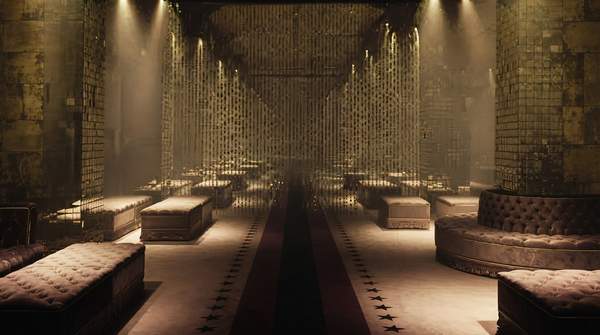
The most ambitious recent example is Dior's A/W 2025 show, staged by the legendary theatre artist Robert Wilson—an ambitious recreation of the dawn of time, with guests seated around a simple LED square in a pitch black room from which emerged a palaeolithic narrative of erupting glaciers and flying dinosaurs. Wilson, Wallpaper* notes, treats lighting as an act of "sculpture," and the show demonstrated how world-building can borrow directly from theatre craft. A show's location itself can be the world: Fendi's spring/summer 2008 show sent 88 models walking the Great Wall of China at sunset, per Coveteur's Ella O'Keeffe.
The Masterminds Behind the Scenes: Creators and Production Houses
Identifying the strategy leads to identifying the responsible hands, and this is where mainstream coverage usually falls silent. The artistic-collaboration route credits its creators by design: Daniel Buren at Louis Vuitton, the mural artists at Prada, the video artist Baillie Walsh—whose hologram of Kate Moss closed Alexander McQueen's autumn/winter 2006 show, art directed by McQueen himself. Robert Wilson's name sits above the theatre world before fashion.
World-building, by contrast, typically depends on specialized production houses. Whitewall's Erica Silverman credits Villa Eugenie with the "moody and lit-from-within" set design for Hermès' show titled "The Rider," where a column of heavy rain descended on a starlit runway under creative director Nadège Vanhee's collection. Firms of this kind execute a designer's narrative with cinematic control of light, scale and atmosphere—yet their names appear in credits, not headlines. This article cannot catalogue every production company behind every iconic set; the examples above mark the structural pattern: a credited artist signals collaboration, a dominant machine signals spectacle, and a named production house usually signals world-building.
Recognizing the Artistry: How to Identify Set Design Strategies
When observing a fashion show, identify the primary conceptual strategy behind its set design by looking for explicit artistic partnerships, prominent technological elements, or a fully constructed, transportive environment. The measurable indicator is concrete: the presence of a credited artist, a dominant technological feature such as robots or drones, or a detailed, non-traditional setting that creates a distinct world.
Test the framework on the next major show you watch. If the credits name a fine artist, ask how their signature vocabulary reframes the collection; if a drone or humanoid robot carries the garments, consider whether the technology is doing narrative work or pure spectacle; if the room has become somewhere else entirely—a supermarket, a cave, the dawn of time—look for the production house in the show notes. That single check tells you who made the world you are standing in.
Sources
- The Best Fashion Show Sets Of All Time — British Vogue
- Futuristic Fashion Show Replaces Runway Models With Drones — TIME
- Robots on the Runway - Robotics Institute Carnegie Mellon University
- Channellife
- Unpacking A/W 2025’s best runway sets — Wallpaper*
- These Are The Most Iconic Fashion Show Locations In History — Coveteur
- 13 Best Set Designs from Fashion Month — Whitewall