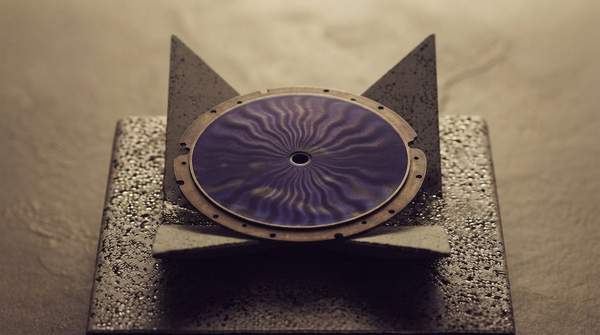
In the world of luxury watchmaking and jewelry, guilloché is a revered decorative craft, distinguished by the intricate, geometric patterns it engraves into metal surfaces. Also known as engine-turning, this centuries-old technique uses specialized, hand-operated machinery to achieve a precision and play of light that modern methods often struggle to replicate. First introduced to watch dials in 1786 by the celebrated watchmaker Abraham-Louis Breguet, the art form was valued not only for its silky, textured aesthetic but also for its ability to enhance a timepiece's functionality.
Traditional guilloché is fundamentally a process of cutting, not deforming, metal. An artisan, or guillocheur, uses a hand-cranked lathe to guide a workpiece against a stationary cutting tool, meticulously removing fine lines to create a pattern. This method produces sharp, deep engravings that create a vibrant, dynamic surface, distinguishing it from contemporary stamping or CNC machining. The complexity and variety of these designs are made possible by two primary types of antique machines, each with a distinct mechanical principle.
The Mechanics of Guilloché: Rose Engine vs. Straight-Line Engine
The mesmerizing patterns of guilloché are not free-form creations but the result of precise, mechanically guided movements. The two principal machines used in this craft, the rose engine and the straight-line engine, generate different families of patterns based on how they manipulate the object being engraved. According to Patek Philippe, a practitioner of the art, the straight-line engine is used for repetitive geometric patterns, while the rose engine can produce a richer variety of designs, including curved lines.
The rose engine creates circular, wavy, and other curved patterns. Its defining feature is a set of cams, known as rosettes, which control the oscillating movement of the workpiece as it rotates. The artisan presses the workpiece against the stationary cutter, and the rosettes guide its path, generating intricate, flowing lines. In contrast, the straight-line engine, which RGM Watch Co. notes is used for patterns cut vertically or horizontally, moves the workpiece in a linear path. This machine, which shares principles with a metal planer, is ideal for creating grids, checks, and other linear designs. Some variations, like the tapestry lathe described by Horopedia, use a master die or pattern bar to mechanically reproduce a design onto the dial.