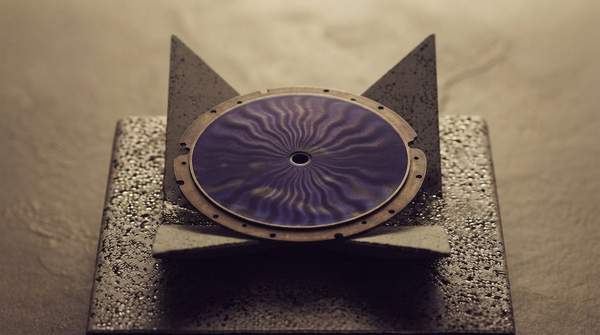
Grand Feu enameling and guilloché are the two most storied artisanal techniques in luxury watch dials, and they are opposites in almost every meaningful respect. Grand Feu enamel is an additive craft: powdered glass is fused onto a metal base in successive layers of extreme heat, producing a deep, glassy surface of unmatched color. Guilloché is a subtractive craft: precise geometric patterns are engraved into the metal itself, creating a dial whose texture reflects light differently from every angle. Understanding that fundamental distinction—glass added by fire versus metal removed by the engraver—is the key to appreciating, and distinguishing, the finest handcrafted dials.
Introduction: The Art of the Watch Dial
Decorative watch dials have existed since the earliest days of mechanical watchmaking, and by the eighteenth century watchmakers were actively exploring ways to improve both the legibility and the visual refinement of the watch face. Among the most influential figures in that development was Abraham-Louis Breguet, who introduced guilloché engraving to watch dials; by cutting delicate geometric patterns into the metal surface, Breguet could separate different sections of the dial and enhance readability, according to the independent watchmaker Sartory-Billard's account of dial craftsmanship. What began as a functional aid to reading the time evolved into an end in itself.
The dial, after all, is the surface the wearer confronts every day, and the two techniques that dominate the high-craftsmanship tradition approach it from opposite directions. One builds up a new surface of fused glass; the other carves into the existing metal. Each carries its own history, its own material logic, and its own visual signature, and each rewards the collector who can recognize what they are actually looking at.
Grand Feu Enameling: The Art of Fire and Glass
The term Grand Feu translates as "Great Fire," and the name is earned. As the American watchmaker RGM Watch Co. describes it, enameling is a technique in which colored powdered glass is applied to a metal plate, and the surface is then heated to a temperature high enough to cause the powdered glass to melt and form a new surface. The Grand Feu technique raises the stakes considerably: it involves meticulously coating a watch dial with successive layers of enamel, each of which must be fired in turn.
The process, as the enameling specialist Manilone explains, involves powdered silica and other compounds heated on a metal base at very high temperatures in successive layers, requiring multiple reheats that ultimately create the deep, glassy surface characteristic of the technique. Layers serve two purposes: building the desired thickness and, where required, achieving multiple colors. The defining hazard is that each return to the kiln jeopardizes all the layers beneath it.
This is why practitioners describe creating an enamel watch dial as a high-risk art. The process is difficult, with a high failure rate, and the failures are unforgiving. As the horological publication Watch Affinity observes, once you appreciate the absolute mastery required, factor in the small scale of a watch dial, and account for the unavoidable rates of failure, you begin to understand why a timepiece with an enamel dial often carries a commanding price. The reward, in Manilone's words, is that nothing else renders color like enamel—it is, essentially, stained glass.