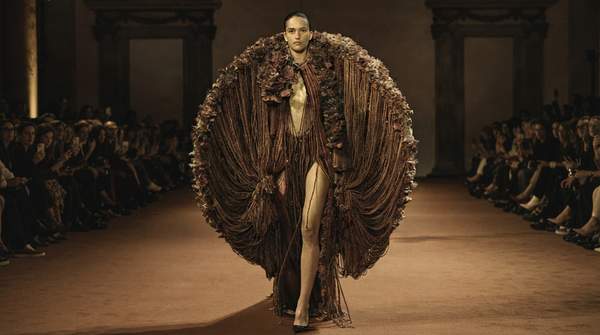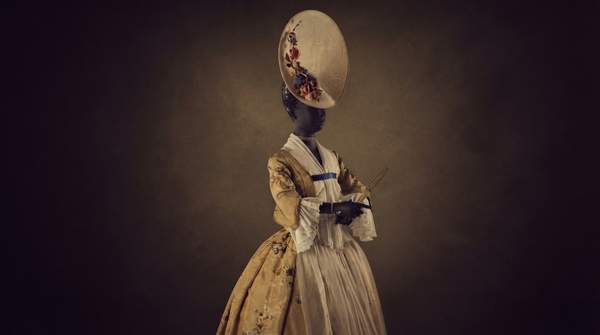
When does a dress stop being a dress? The most persuasive answer in twentieth-century fashion comes from two French houses: Yves Saint Laurent put paintings onto the body so literally that museums had to respond, and Karl Lagerfeld spread himself across art history, photography and couture until the boundary dissolved on its own. Their routes to institutional recognition were different—one built on the garment as art object, the other on a designer who was also an exhibiting artist—and comparing them clarifies what "fashion as fine art" actually means in practice.
Yves Saint Laurent: Direct Artistic Translation
Saint Laurent's method was the most literal imaginable. As the Museum at FIT observes in its material on art and fashion, he famously recreated the color blocks of Piet Mondrian, and the crucial point is what happened next: the couturier masterfully applied the flat motif to the three-dimensional body. That is the technical achievement that separates homage from art. A Mondrian canvas is a flat arrangement of geometry; a dress has shoulders, a waist, a moving wearer. Translating one into the other without losing the composition is a formal problem, solved formally.
The same instinct recurred throughout his career. The Metropolitan Museum of Art's perspective essay on Saint Laurent describes standing before Van Gogh's Irises (1890) and imagining an interpretation in which the petals are crafted with overlapping sequins and the leaves demarcated with precise rows of cornflower blue bugle beads. That imagined garment is not hypothetical: the Met holds the resulting ensemble from spring/summer 1988, in silk, glass, metal and pearls. Van Gogh's brushstrokes become beadwork; the painting's texture becomes a surface you can wear.
Institutional Recognition for Saint Laurent
Translation alone does not confer artistic status—institutions do. Saint Laurent received the decisive form of it: a solo exhibition at The Metropolitan Museum of Art's Costume Institute, the first time the institute dedicated a solo exhibition to a living designer. The significance is hard to overstate. The Costume Institute had previously honored designers, but a retrospective devoted to one living couturier's entire output treated the garments not as costume or commerce but as a coherent body of work—the way a museum would treat a painter.
The Met's continued engagement makes the point durable. Its perspective essay reads Saint Laurent's 1988 Van Gogh ensemble directly against the painting that inspired it, holding garment and canvas in the same analytical frame. When a museum curator describes a dress in the language of brushstrokes, lines and hue, the institution has already answered the question of whether the object belongs in the conversation.
Karl Lagerfeld: Art History and Beyond
Lagerfeld's engagement was diffuse where Saint Laurent's was direct. As the Met notes in its writing on the exhibition Karl Lagerfeld: A Line of Beauty, he often consulted both fine and decorative arts for inspiration while designing collections every season for Chanel, Fendi, Chloé and his eponymous label, among others. The exhibition itself presented pieces containing varied and often surprising references to the history of art. Rather than one signature translation, Lagerfeld's method was a constant, omnivorous absorption of art into fashion across houses and decades.
One documented example shows how oblique his references could be. A fully beaded Chanel evening gown from the spring/summer 1984 couture season—only his third couture collection for the house, embroidered by the House of Lesage—carried blue-and-white porcelain-inspired motifs that Lagerfeld, in a January 1984 Women's Wear Daily article, described as being "right out of a portrait by Sargent." The Met pairs the gown with John Singer Sargent's The Daughters of Edward Darley Boit (1882). The reference runs through porcelain, through paint, onto the body: a chain of association rather than a copy.
Lagerfeld's Art-World Presence
What most sharply distinguishes Lagerfeld, though, is that his recognition was not confined to fashion. As Phaidon's editorial team has noted, a number of designers have engaged with art in a more traditional manner, branching outside fashion into widely agreed-upon forms of fine art such as sculpture and photography—and Lagerfeld is among the couturiers whose work has been shown in galleries and museums around the world as visual art. The Met's own framing reinforces this: Lagerfeld's propensity to interweave disparate modes of creative production demonstrates, in its words, the fundamental permeability between these discursive categories.
This is the structural difference between the two men. Saint Laurent's artistry lived inside the garment; the museum retrospective was the recognition of clothing as art. Lagerfeld's artistry also existed alongside the garment, in a photographic practice exhibited independently. A designer who photographs, and whose photographs hang in galleries, is not waiting for fashion to be admitted to the category of art—he has simply entered it through another door.
Comparative Paths to Artistic Recognition
Setting the two careers side by side makes the divergence visible. The table below compares each designer's method, a representative art-inspired work, and the form of institutional recognition each received.
| Designer | Primary Artistic Method | Key Art-Inspired Work | Form of Institutional Recognition |
|---|---|---|---|
| Yves Saint Laurent | Directly translated fine art compositions onto garments, masterfully applying flat motifs to the three-dimensional body. | The 1965 Mondrian collection, recreating Piet Mondrian's color blocks; later, the beaded 1988 Van Gogh Irises ensemble. | A solo exhibition at The Metropolitan Museum of Art's Costume Institute—the first solo exhibition the institute dedicated to a living designer. |
| Karl Lagerfeld | Consulted fine and decorative arts for inspiration across Chanel, Fendi, Chloé and his own label, while also practicing as a fine art photographer. | Collections for multiple houses with varied art-historical references, such as the 1984 Chanel gown whose porcelain motifs he described as "right out of a portrait by Sargent." | Recognized for both fashion design and photography, with work shown in galleries and museums around the world, including Karl Lagerfeld: A Line of Beauty. |
The comparison yields a clear finding: Saint Laurent achieved artistic status primarily through garments that directly translated fine art, culminating in a solo fashion retrospective, while Lagerfeld's recognition stemmed from both art-inspired fashion and a distinct, exhibited fine art photography practice. One made the dress the art object; the other made himself the artist.
Understanding Fashion's Artistic Evolution
To fully appreciate how fashion transcends its commercial function, observe the distinct methods designers employ to engage with and be recognized by the fine art world. The clearest measure of that recognition is the occurrence of major museum exhibitions dedicated to a designer's work—whether fashion-focused retrospectives like Saint Laurent's at the Costume Institute or displays of a designer's non-fashion artistic output, as in Lagerfeld's case. Neither exhibition settles the philosophical debate about whether fashion is art, and neither needs to. What they settle is the institutional question: when a museum builds a show around the work, the work has entered the museum's territory on the museum's own terms. That is the standard, and these two designers met it by two different roads.