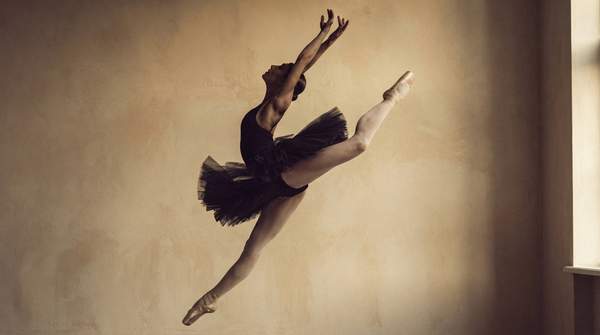
Ballet has never merely decorated fashion; it has redrawn it. Across two centuries, the stage costume's defining demands—freedom of movement, weightless fabric, and an unobstructed view of the body's line—have repeatedly migrated from the rehearsal studio into the couture atelier. The clearest cases are traceable: the Romantic tutu's ethereal layers feeding a nineteenth-century taste for sheer, flowing dress; Léon Bakst's orientalist designs for the Ballets Russes electrifying Paul Poiret's couture; and Coco Chanel's own costume work for the Ballets Russes flowing back into her movement-first collections. This is a story of specific aesthetic transfers, not vague mutual admiration.
Romanticism's Ethereal Embrace: The Tutu and Fluid Silhouettes
The first great transfer began in the 1830s, when Romantic ballet established the tutu as the emblem of the ethereal dancer. What made the costume revolutionary was its material logic: layers of tulle, a fabric light enough to float, wrapped around a bodice that let the body move. As SELVANE's editorial history of ballet's fashion influence describes, the desire for light, flowing silhouettes, the embrace of sheer fabrics like chiffon and organza, and an emphasis on a delicate, almost fragile beauty then permeated women's dress, moving away from the rigid structures of earlier periods toward a more poetic and dreamlike aesthetic.
The significance of this shift is worth pausing on. Ballet did not simply offer a decorative motif that fashion borrowed; it dictated a new form of physical expression and, simultaneously, reshaped the aspirational ideal of feminine grace in everyday attire. The corseted, architectural dress of earlier decades gave ground to garments that could move as the wearer moved—an early instance of the stage's functional requirements rewriting the wardrobe of ordinary life.
The Ballets Russes Revolution: Orientalism and Avant-Garde Couture
The second decisive moment arrived in 1909, when Serge Diaghilev's Ballets Russes brought classical Russian ballet to the West, principally in Paris. As the Wikipedia survey of ballet and fashion records, fashion designers and haute couture were directly inspired by the influential company, and Léon Bakst served as the troupe's principal costume designer in the early 1900s. Bakst's designs—vivid, orientalist, and built for theatrical movement—did not stay confined to the stage.
Paul Poiret, the Parisian couturier who also designed for the company, was among those inspired by Bakst's work. The Fashion Globe's historical account frames the consequence in structural terms: the Ballets Russes aesthetic contributed to the abandonment of the corset and the embrace of flowing, oriental-inspired silhouettes in couture. Here the influence was not merely chromatic or decorative. A costume designed to let a dancer leap and turn became the argument for freeing the fashionable body from its own constraints—one of the most consequential exchanges between the two forms.