Bespoke shoemaking is the creation of a shoe entirely by hand, built around a unique three-dimensional model of one client's foot and executed through a fixed sequence of craft stages: measurement and last creation, pattern making and cutting, upper stitching, lasting, welting and sole attachment, and hand-finishing. The Fondation Rémy Cointreau, which documents endangered craft traditions, describes the discipline as demanding mastery of hand movement and deep knowledge of the material, noting that only around thirty highly qualified independent practitioners still work in France today. Understanding the order and purpose of each stage is the key to understanding why the result fits as no factory shoe can.
The Essence of Bespoke: Unparalleled Fit and Craftsmanship
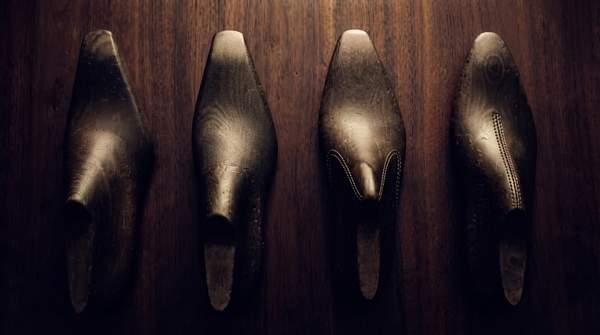
What separates bespoke from ready-to-wear and even made-to-order footwear is the custom last. As the shoemaking house Bondeno explains, the shoemaker creates a last—a three-dimensional model of the client's foot—that serves as the foundation for building the shoe, with the upper then shaped over it to give the shoe its final form. FEIT, a handmade-footwear maker, emphasizes that the term "bespoke" implies a product made from scratch for a specific client, and that its practitioners take pride in doing things "the hard way," achieving tight stitches, smoothly beveled sole edges, and comfortable fits through inherited knowledge and skilled hands rather than high-tech machinery.
The Fondation adds that the bespoke shoemaker "creates entirely by hand," meticulously applying every step of realization, from cutting to stitching to polishing. The distinction rests on two pillars: a last unique to each client, and manual skill exercised at every stage.
Stage 1: Initial Consultation and Custom Last Creation
The process begins with the client's feet. Precise measurements and an imprint of the foot are taken, and from these the shoemaker sculpts a last—traditionally in wood, though Bondeno notes that 3D scanning and printing now allow custom lasts that perfectly match the client's foot shape. Whether wooden or plastic, the last is the foundation of everything that follows: every pattern, every stitch, and every shaping operation is performed around it. This is the stage that mass production cannot replicate, because a factory last is a standardized approximation of an average foot, while the bespoke last is a faithful record of one person's anatomy and preferences. The Fondation describes the shoemaker's work as starting with "an imprint of the foot sculpted on wood," a formulation that captures the sculptural, individualized character of this foundational step.
Stage 2: Pattern Making and Upper Preparation
With the last established, the design is translated into flat patterns that will conform to its three-dimensional curves. The Fondation's profile of Claire Daubé, a made-to-measure boot and shoemaker specializing in the upper—the part of the shoe that covers the foot—identifies the two complementary skills of this stage as patternmaking and sewing. Her work, the Fondation notes, directly influences the shoe's aesthetics, comfort, and durability, which is why the upper is treated as a discipline in its own right. The leather pieces are then precisely cut and closed—stitched together by hand to form the complete upper. The Fondation's account of the shoemaker's handwork lists punching, gluing, riveting, and stapling among the manipulations applied to the leather pieces, indicating the range of manual operations that assembly demands before the upper ever meets the last.
Stage 3: Lasting – Shaping the Shoe
Lasting is the moment the shoe acquires its form. The stitched upper is stretched and molded over the custom last, and Bondeno describes it as a defining feature of bespoke shoemaking that sets it apart from mass-produced footwear. The firm is emphatic that the essence of the process is unchanged by technology: lasting "requires skill, patience, and a deep understanding of the craft," and the shoemaker's expertise and attention to detail remain critical to achieving the perfect fit and finish whether traditional wooden lasts or modern plastic ones are used. The stakes are high because lasting is irreversible in effect—the upper, once shaped and secured, holds the memory of the last beneath it. A careless lasting operation cannot be corrected later; a careful one is what allows the finished shoe to mirror the client's foot.
Stage 4: Welting and Sole Attachment
Once the upper is lasted, the sole structure is attached. In the traditional hand-welted method, a strip of leather—the welt—is sewn to the upper and insole while the shoe remains on the last, and the outsole is then stitched to the welt. This construction is what makes the shoe durable and, importantly, resoleable: because the sole attaches to the welt rather than directly to the upper, the sole can be replaced without destroying the shoe. The Fondation's description of the shoemaker's sequence—cutting, stitching, then the manipulations of leather pieces and finally polishing—places sole attachment among the core hand operations of the craft.
The Barcelona bespoke shoemaker Norman Vilalta's workshop, writing about its finishing process, refers to the moment of cutting the leather to open the channel and sew the welt, confirming that the welt seam is worked into the sole leather itself, a step whose traces persist into the final finishing.
Stage 5: The Art of Hand-Finishing
The final stage refines both appearance and protection. Vilalta's workshop describes a finishing process that may seem "repetitive and overkill," but which creates a final sealing of the leather fibers and wax, producing the shine characteristic of bespoke shoes. Sole finishing receives its own attention: when a closed-channel sole is made, irregularities remain along the edge where the channel was originally cut to sew the welt, so the workshop applies an extra iron and wax to create a decorative edge along the sole. This is craft in its most concentrated form—hours of hand work whose purpose is partly structural, sealing fibers against wear, and partly aesthetic, delivering the depth of finish that machine production imitates but does not replicate.
The Bespoke Shoemaking Journey: A Step-by-Step Timeline
Assembled from the accounts of practicing shoemakers and craft foundations, the stages below follow one another in a fixed order, each building on the last. The specific techniques and nomenclature may vary slightly between artisans, but the overall progression—from custom last, through shaping and welting, to hand-finishing—is consistent across traditional methods.
| Stage | Key Actions | Purpose |
|---|---|---|
| 1. Initial Consultation & Measurement | Precise measurements and an imprint of the client's feet are taken. | Ensures the shoe is tailored to the individual's measurements and preferences. |
| 2. Last Creation | A unique last—a wooden or 3D-printed model of the client's foot—is sculpted or produced. | Perfectly matches the client's foot shape and forms the foundation for the entire shoe. |
| 3. Pattern Making & Cutting | Patterns are derived from the last and the upper's leather pieces are precisely cut. | Translates the design into components ready for assembly. |
| 4. Upper Closing & Stitching | The cut leather pieces are stitched together by hand, with punching, gluing, riveting, and stapling as needed. | Forms the upper, whose seams determine the shoe's aesthetics, comfort, and durability. |
| 5. Lasting | The stitched upper is stretched and molded over the custom last. | Gives the shoe its final shape; demands skill, patience, and deep craft understanding. |
| 6. Welting & Sole Attachment | A welt is sewn to the upper and insole, and the sole is hand-stitched to the welt. | Ensures durability and allows the shoe to be resoled without destruction. |
| 7. Hand-Finishing | Repeated waxing and ironing seal the leather fibers; sole edges receive extra iron and wax. | Produces the signature shine, a decorative sole edge, and protection for the leather. |
Embracing the Craft: The Enduring Value of Bespoke Footwear
To appreciate bespoke shoemaking is to recognize it as a significant investment in craftsmanship—one that delivers fit, durability, and personal expression unavailable from mass production, precisely because a unique last and hours of hand work stand behind every pair. The Fondation's warning that this savoir-faire is endangered, with only around thirty independent practitioners remaining in France, gives that appreciation urgency. For the reader evaluating any shoe presented as bespoke, the verification is tangible: the presence of a custom-made last and visible hand-stitched details on the shoe. Those two observable markers distinguish a genuinely bespoke creation from an imitator, and they remain the measurable test of the craft described here.
Sources
- SAVOIR-FAIRE OF SHOEMAKING - Fondation Rémy Cointreau
- The Art of Lasting in Bespoke Shoemaking: A Detailed Exploration — Bondeno
- Master Shoemakers: Handcrafted Footwear Art — FEIT
- The Art of Hand Finishing, Part 1 — Norman Vilalta Bespoke Shoemakers