Haute couture embellishment is not one craft but a constellation of them, and the curricula of professional programs make that scope unusually legible. Polimoda's short course in the discipline identifies four pillars: precision hand embroidery on luxury textiles, professional featherwork application and finishing, hand beading with a needle, and demonstrations of the advanced Luneville hook. Synthesizing that coursework with the tambour tradition it draws from yields a more useful map than any single syllabus: these skills divide into three families — surface additions, fabric manipulation, and dimensional creations.
Introduction to Haute Couture Embellishment
What distinguishes couture embellishment from ordinary dressmaking decoration is not ornament alone but the standard of execution. Polimoda frames its intensive around "technical mastery," pairing each technique with material recognition and selection for high-end projects, attention to detail, and traditional finishing techniques "that ensure longevity and durability." Students are expected to develop texture, color and dimensional design principles, and to learn how embellishment enhances a garment's silhouette and movement — a reminder that in couture, decoration is structural to the design, not applied as an afterthought.
The craft also carries an interpretive burden. The Polimoda course lists problem-solving for "complex decorative challenges" and the ability to translate design concepts into "tactile embellishment solutions" among its outcomes. The artisan, in other words, is a bridge between the atelier sketch and the finished surface — a role that explains why programs teach a breadth of methods rather than a single specialty.
Surface Additions: Adorning the Fabric
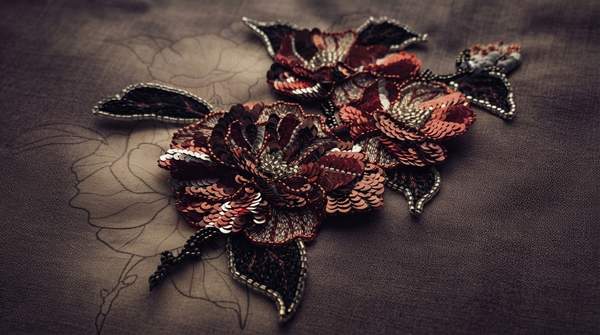
The first and most familiar family comprises techniques that attach decorative elements onto the fabric's face. Hand embroidery, the foundation of the Polimoda syllabus, works thread directly into luxury textiles; featherwork, taught there as professional "application and finishing," goes further, converting a pliable natural material into structured floral and textural motifs. Beading — by needle or hook — completes the family, as does the bead-and-sequin tambour work that appears throughout couture collections.
The visual range of this family is best seen in the examples By Hand London catalogs from Chanel's Spring/Summer 2019 haute couture show: flowers made from tiny cut pieces of fabric, a floral embellishment made from feathers, and bead and sequin tambour work — three radically different textures, all surface treatments. The By Hand London writer, surveying couture embroidery, traces much of the sparkle to tambour, or Luneville, embroidery, citing a Jean Paul Gaultier dress embroidered by Maison Lesage as an exemplar of the tradition. Within this one family, then, the couturier must command thread, feather, bead and sequin as distinct materials with distinct behaviors.