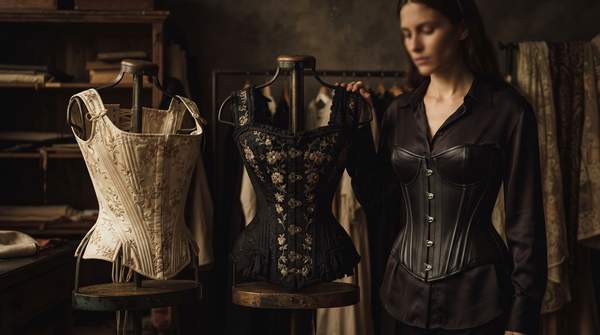
The corset's history is a story of technology chasing the body. What began in the eighteenth century as a rigid, cone-shaped foundation worn beneath elaborate gowns became, over two hundred years, an instrument of the hourglass waist, a medicalized "health" garment, and finally a visible emblem of rebellion on the runway and the street. Tracing its evolution reveals a consistent pattern: each time structural innovation changed what the corset could do to the body, fashionable silhouettes and cultural meanings changed with it.
The Corset's Origins: 18th Century Stays and Conical Silhouettes
Eighteenth-century stays bore little resemblance to the cinched-waist garment the word "corset" now conjures. According to The Museum at FIT, eighteenth-century stays created a cone-shaped silhouette, and the historical record of corsetry describes the most common type of the period as an inverted conical form, worn to create a contrast between a rigid, quasi-cylindrical torso above the waist and heavy full skirts below. The garment's job was not to shrink the waist but to provide a smooth, architectural base upon which the elaborate draped gowns of the aristocracy could sit.
These stays were also social furniture. By the late eighteenth century, as Kendra Dresser writes in IRK Magazine, stays had become central to court life, supporting the structured bodices of gowns like Marie Antoinette's Robe à la Française. The garment's authority was already established when fashion began to move away from it: The Museum at FIT notes that by the 1790s, the new fashion for high-waisted dresses led some women to adopt shorter stays resembling proto-brassieres. The old conical rigidity loosened its grip before the nineteenth century even began.
Victorian Era Transformations: Mass Production and the Hourglass Ideal
The nineteenth century industrialized the corset. The Victoria and Albert Museum identifies the 1850s as the turning point, when the uptake of sewing machines enabled the mass production of clothes, and corsetry acquired new hardware: metal eyelets, the first steel front busk fastening, and various lacing mechanisms, as one history of corset construction documents. The Vintage Fashion Guild dates the front-fastening busk to 1848, an innovation that allowed a woman to dress herself quickly, without assistance, and notes that factory production from the late 1860s brought standardized waist sizes from 18 to 30 inches.
These were not minor conveniences; they reshaped the silhouette itself. As Dresser recounts, whalebones, metal eyelets, and spoon busks shaped dramatic figures while sewing innovations made corsets widely accessible. The V&A's collection includes an 1883 corset reinforced with leather, evidence of the structural demands placed on the garment at the height of the hourglass ideal. The corset had shifted from a support for clothing to an active instrument of body modification, and industrial production put that instrument in far more hands than the bespoke corsetière ever could.