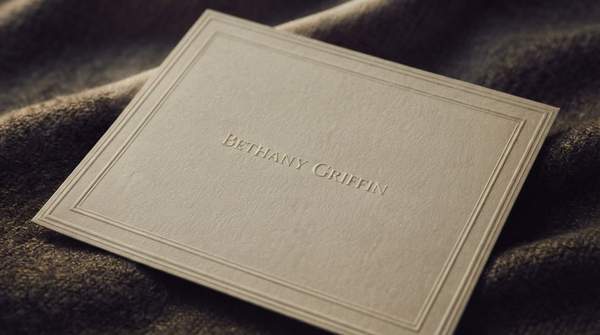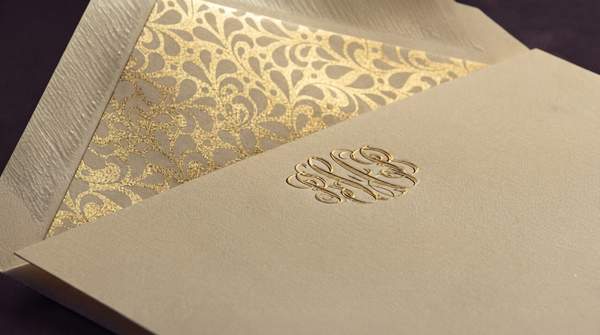
Engraving is an intaglio printing process: a design is cut into a metal plate, ink is drawn from the recessed lines onto paper under pressure, and the result is ink that physically rises above the page. That single mechanical fact explains both its luxury status and its most reliable fingerprint. Run a fingertip across the front of a genuinely engraved card and you feel raised ink; turn it over and you find a subtle indentation, the telltale "bruise" left by the press. No other common stationery method produces that pairing.
The Enduring Appeal of Engraved Stationery
What makes engraving a luxury method is not branding but physics and labor. Because the image is carried below the surface of a steel plate rather than sitting on top of a relief block, the ink is squeezed into the paper under high pressure, producing what Crane Stationery describes as crisp, elevated ink with a level of detail no other process matches. The plate itself is a crafted object: engravers carve intricate designs into steel using specialized tools, a process that can take hours or even days for a single plate, according to Crane's account of its own workshop.
The craft carries a longer history than the stationery trade alone. Florida State University's research guide on the history of text technologies defines engraving as an intaglio printmaking process in which an artist cuts lines into a metal plate with a tool called a burin, the same technique that carried fine printmaking for centuries. When applied to personal stationery, that lineage becomes a statement about the sender: the Ephemera Society of America's historical account of engraved social stationery documents how the medium once anchored formal correspondence, with plates of alphabets, numerals and monogram systems maintained as reusable assets of the trade. The appeal, then, is partly tactile and partly social, a way of signaling care through the slowest available means of putting ink on paper.
The Artisanal Process of Engraving: Step-by-Step
The process begins with the plate. Two routes exist for creating it. In direct hand engraving, the artisan cuts the design into steel with a burin, as the FSU guide describes. In the workshop method documented by Gary Horsman for the Ephemera Society, the metal is first coated with an acid-resistant ground, a sharp needle in a pantograph machine traces the letters through that coating, and acid is then applied by eye-dropper to eat into the exposed metal. Either way, the fundamental outcome is the same: a plate whose lines sit below the surface, ready to hold ink.
Horsman's account details the variables that make this a craft rather than a procedure. Engravers typically work with a 10x loupe in one eye, because the system can reduce letters to the point that a magnifying glass is required to read them. Ambient temperature, humidity, variance in the quality of the steel, and the craftsman's skill all factor into the result. Sometimes the acid cuts to the full required depth on its own; sometimes the engraver must finish the job by hand with a graver or burin.
Printing follows the intaglio sequence. The plate is inked so its recessed lines fill, and the surface is wiped clean, leaving ink only in the incisions. Damp paper is then laid over the plate and pressed under high pressure, forcing the paper into the lines so it lifts the ink out. As the printmaking resource from Studio Burke explains, the finished impression is shaped by the choice of ink, the method of wiping, the paper, and the skill of the craftsman, and the plate's contours leave an embossment called the platemark. The engraver proofs the plate, works it further, and repeats until the design is complete, a stage-by-stage evolution known as states.
Engraving vs. Other Printing Methods
The clearest way to understand engraving is to set it beside the techniques it is most often confused with. The table below compares the four methods readers are most likely to encounter on fine stationery, organized by how the image reaches the paper and what the result feels like.
| Method | Process | Resulting Texture | Best For |
|---|---|---|---|
| Engraving | Intaglio: ink held in recessed lines of a metal plate is transferred to damp paper under high pressure, causing the ink to rise. | Crisp, elevated ink on the front with a subtle indentation ("bruise") on the reverse. | Luxury communication and formal stationery demanding precision and a distinctive tactile feel. |
| Letterpress | Relief printing: ink is applied to a raised surface that presses into the paper. | A debossed impression pressed into the sheet; no raised ink. Depth varies with pressure. | Designs seeking a pressed, sculptural character. |
| Thermography | A post-printing process: resinous powder is dusted onto wet ink and fused by heat, causing it to rise. No pressure is applied. | Raised, often glossy and smooth ink surface; lacks the crispness and reverse indentation of engraving. | A raised look at lower cost, for cards and invitations. |
| Digital | Ink or toner applied directly to the paper surface without pressure. | Completely flat and smooth; no tactile dimension. | Full-color and everyday use where speed and versatility matter. |
The mechanical distinction matters. Letterpress is the mirror image of engraving: relief rather than intaglio, pressing ink into the sheet instead of lifting it out. Thermography achieves a raised effect through heat rather than pressure, which is why it can imitate engraving's silhouette but not its structure. As Olympus Press's glossary describes, slow-drying ink is dusted with resinous powder that melts and fuses in a heat chamber, and TOG.ink notes the process began in the early 1900s as an affordable alternative to engraved stationery. Hodgins Engraving, a shop offering both, notes that thermography can look matte or glossy depending on the powder, and that its appearance depends on ink coverage in the design.
Cost follows from the mechanics. The Print Authority points out that engraving requires a separate plate for each design, which is costly, while thermography requires no additional plates and is cheaper and faster to produce. That trade-off is the honest heart of the comparison: thermography buys the look of raised print without the plate, the press, or the bruise.
Identifying Authentic Engraved Stationery
To identify authentic engraved stationery, examine the paper for distinctively raised ink, a subtle indentation (the bruise) on the reverse side, and a crisp, precise image. The measurable indicator is the pairing of a tactile, raised ink surface on the front with a corresponding indentation on the back of the paper, the signature of intaglio pressure that no imitation reproduces.
Letterpress is its opposite: the impression goes in, not up. Thermography is the one worth testing carefully, because it is engineered to resemble engraving. Its raised surface comes from fused powder, so it tends toward a glossy or slightly uneven texture, and Wikipedia's entry on thermographic printing notes that the uneven quality of the text is a result of the process and easily differentiates it from engraving. If the ink is raised but the reverse of the sheet is smooth, heat, not a plate, made the relief.
For anyone commissioning stationery, the practical test is simple and requires only fingertips and light: feel the front, then turn the sheet over. A raised front with a bruised back is engraving; a pressed-in front is letterpress; a raised front with a flat back is thermography; a flat sheet is digital. The distinction is not merely technical, it is the difference between a plate carved over days and a powder melted in seconds, and between the price tags that follow.
Sources
- Research Guides: History of Text Technologies: Engraving and Etching
- Printing Processes - Crane Stationery
- Engraved Social Stationery - Ephemera Society of America
- What is Intaglio Engraving? Is hand engraved stationery the finest pro — STUDIO BURKE DC
- Thermography — Olympus Press - Seattle, WA
- What is thermography? - TOG.ink/blog
- Thermography — Hodgins Engraving
- Thermography Printing: How it Works & Best Business Uses — The Print Authority
- Thermographic printing - Wikipedia — EN