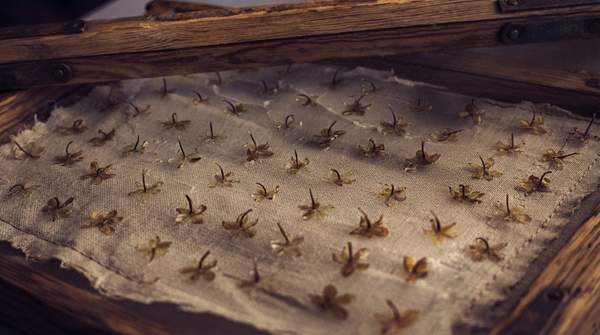
The choice between the two traditional fat-based methods of solid perfume making comes down to a single question about the flower itself: does it keep releasing fragrance after picking? If the answer is yes — as with jasmine and tuberose — the delicate, unheated process of cold enfleurage lets the living flower keep perfuming a layer of fat on a glass plate, day after day, until that fat becomes a scented pomade. If the scent is instead locked in the petals and released only with warmth — as with rose and orange blossom — the perfumer turns to maceration, sometimes called hot enfleurage, steeping the botanicals in gently heated fat. The pomade that results is, on its own, a solid perfume.
The Enduring Art of Enfleurage: Capturing Nature's Most Delicate Scents
Enfleurage is, at its heart, an arrangement between fat and flower. The method relies on fat's ability to dissolve and hold fragrant molecules, with no heat in the cold process and only gentle heat in the hot one. Fresh flowers are laid on, or steeped in, odourless fat, which absorbs their aromatic compounds; the scented fat — the pomade — can then, if the perfumer wishes, be washed with alcohol to produce a concentrated material called an absolute. But the pomade itself needs no further chemistry. It is already a wearable solid perfume, a balm carrying the flower's voice.
The cold technique was developed in southern France in the eighteenth century for the production of high-grade concentrates, an account of its history given in the Wikipedia entry on the method. Its modern decline is well documented by perfume writers: as one explainer from Premiere Peau describes, three forces killed commercial enfleurage — low yield compared with solvent extraction, extreme labour intensity, and the disappearance of flower fields around Grasse as land went to property developers. By the 1930s, solvent extraction had replaced it at industrial scale, and newer methods such as supercritical CO2 extraction have since made industrial capture faster still. What survives is an artisan's practice, pursued for a reason no efficiency argument can touch.
Comparing Cold Enfleurage and Maceration
The comparative framework below sets the two methods side by side across the variables that actually determine the choice: heat, flower physiology, and process duration. The reasoning is straightforward. Flowers that perfume after harvest can be laid on cold fat and left to work; flowers that hoard their scent in their petals need warmth to give it up.
<<
| Dimension | Cold Enfleurage | Maceration (Hot Enfleurage) |
|---|---|---|
| Heat | None; flowers rest on solid fat at room temperature. | Gentle; fat heated in a bain-marie to between 40 and 60 degrees Celsius. |
| Process type | Fresh flowers laid on the fat and replaced every day or so, for weeks, until the fat is saturated. | Sturdier botanicals stirred into warm melted fat for roughly two hours, strained out, and replaced — repeated daily for several weeks. |
| Suitable flowers | Delicate flowers that keep releasing scent after picking, above all jasmine and tuberose; lilac is a classic case. | Sturdier flowers whose scent is locked in the petals, such as rose, ylang-ylang, cassie and orange blossom. |
| Key process step | Repeated replacement ("charging") of spent flowers with fresh ones on the fat. | Stirring into warm fat, straining, and replacing the botanical material. |
| Resulting scent profile | A unique, true-to-life scent shaped by gentle, prolonged absorption without heat. | A quicker result that captures the scent profile of the heated flower; heat slightly alters the scent. |
Read this way, the table is a decision tool as much as a description. A perfumer holding jasmine knows immediately that the flower's post-harvest generosity belongs to the cold chassis; a perfumer holding rose petals knows the heat of the bain-marie is what will coax their fragrance free. WhatScent's explainer, by Clara Wen, summarises the distinction plainly: fat does the extracting in both cases, and the botanical's behaviour after picking decides which version of that extraction it can withstand and reward.
The Step-by-Step Process of Cold Enfleurage
What follows is a conceptual model of the cold process — the sequence an artisan follows from bare fat to finished pomade, drawn from the accounts of Prosody London, the Wikipedia entry and Premiere Peau. It is not a recipe with measurements; the traditional ratios and exact number of charges varied with the flower and the fat.
- Preparing the chassis and fat. A large framed glass plate, called a chassis, is smeared with a layer of odourless, semi-solid animal fat — historically lard from pork or tallow from beef — and the fat is allowed to set.
- Applying the first layer of flowers. Freshly picked petals or whole flowers are gently pressed onto or laid across the surface of the fat.
- Waiting for diffusion. The botanical matter rests on the fat while its scent diffuses into it, typically over one to three days.
- Charging — replacing the flowers. The spent flowers are removed and replaced with fresh ones, and this replacement is repeated regularly — every day or so — to ensure continuous extraction.
- Repeating to saturation. The charging continues, in the traditional accounts for twenty-five to thirty-six repetitions over several weeks, until the fat has reached the desired degree of fragrance saturation.
- Harvesting the pomade. The now-saturated, scented fat is the pomade — a solid perfume in itself. Those who wish can go further and wash it with alcohol to separate the fragrance compounds into an absolute, but the pomade stands complete as it is.
The labour embedded in those steps is the method's character. Every step was manual, which is precisely why industrial perfumery abandoned it; and the duration — days to weeks of quiet, repeated tending — is inseparable from the gentleness that makes the method work.
Why Enfleurage Persists: Capturing Unique Olfactory Profiles
The claim that keeps enfleurage alive despite its obsolescence is not about strength or refinement. As Premiere Peau puts it, the absolute produced by enfleurage smells different from the absolute produced by solvent extraction — "Not stronger. Not more refined. Different." The difference begins with what the method captures: a living flower, still breathing out fragrance for days after harvest, giving its scent to cool fat over weeks without a single degree of heat to alter it.
Some flowers make that uniqueness unavoidable rather than merely desirable. The Natural Perfumery Academy's account of lilac is the clearest case: once picked, the delicate fragrance fades quickly, and unlike roses or lavender, lilacs yield no essential oil through steam distillation — which makes enfleurage one of the only ways to capture their true scent and preserve the bloom beyond its season, whether in a perfume, a solid balm or a scented oil. For a flower like that, the artisanal method is not one option among several; it is nearly the only door.
Among practitioners, the reward is felt to justify the patience. Whitney Swales of Wit & West Perfumes, writing from six years of trial and error with the technique, describes enfleurage as a process with no shortcuts, one she would recommend to those with a passion for slow, hand-made creation — and one that has afforded her unique fragrances as part of her Reserve Collection. Her testimony is personal practitioner reporting, not a laboratory result, but it matches the structural fact behind the craft: total global output of enfleurage materials today is probably in single-digit kilograms per year, by Premiere Peau's estimate — invisible against hundreds of tonnes of jasmine absolute consumed annually — and yet its influence exceeds its volume.
Embracing the Legacy of Enfleurage for Unique Scents
The decision this history points to is the one at the heart of the craft: for perfumers seeking to capture the most authentic and delicate scent profiles of 'living' flowers like jasmine and tuberose, the labor-intensive cold enfleurage method remains a valuable, albeit niche, artisanal choice over modern extraction techniques. Maceration answers the needs of sturdier botanicals — rose, orange blossom, ylang-ylang — with heat and speed. Cold enfleurage answers a need no industrial method answers at all: the living scent of a flower that keeps giving after the stem is cut.
Whether that value justifies weeks of daily charging is each maker's own calculus, and the honest measure of the method's survival is the continued availability and use of enfleurage-derived pomades or absolutes in limited-edition or high-end natural perfumes — a small output, in single-digit kilograms per year by current estimates, whose persistence is the surest sign that what it captures cannot be captured any other way.
Sources
- Enfleurage - Wikipedia
- Enfleurage: The Near-Extinct Art of Capturing Scent — Premiere Peau
- Enfleurage Explained: Cold vs Hot Method — WhatScent
- 5 best flower perfume extraction methods - Prosody London — Prosody London - natural perfume, vegan, plant based organic fragrance
- Enfleurage, a Beautiful Way to Capture the Scent of Flowers — Natural Perfumery Academy
- The Art of Enfleurage in Perfumery: 2 Methods — WIT & WEST